http://www.sfgate.com/cgi-bin/article.cgi?f=/c/a/2012/02/12/MNU11MQII3.DTL&type=science&ao=2

Rodney Jackson on a mission to save the snow leopard

Meredith May, Chronicle Staff Writer, SFgate.com

Sunday, February 12, 2012

Biologist Rodney Jackson can pinpoint the moment he transformed from a student of nature to a full-blown conservationist.

While walking along a river in Nepal in 1977, he came upon the skinned carcass of a snow leopard, its front paws curved inward as if in agony, its tail arching skyward like a question mark.

He no longer wanted to simply take wildlife pictures of the endangered Himalayan cat. He knew he would dedicate the rest of his life to saving it.

Jackson photographed the gruesome find, then tracked down the hunter who had killed the animal with a poison spear. He paid $15 for the ice-gray pelt with black rosettes and presented it to Nepalese officials to prove poachers were killing the snow leopard despite international bans.

“I originally went to Nepal after I saw the first pictures of a snow leopard in National Geographic,” said Jackson, 67. “It was such a majestic animal, I needed to see one. And I thought I could take a better picture. I left Nepal with an entirely different idea of what I needed to do.”
World expert

Today, Jackson is one of the world’s foremost experts on the elusive snow leopard, an almost invisible animal that lives on some of the world’s highest peaks in Nepal, Pakistan, India, Siberia, Mongolia and Tibet. One of the hardest animals to count, its population estimate is rough: approximately 4,000 to 7,500 snow leopards spread out over half a million square miles of inhospitable habitat.

Along with his companion, Darla Hillard, Jackson runs the Snow Leopard Conservancy from their modest Sonoma home, a shaded retreat decorated with Tibetan art and prayer flags and lorded over by a 17-year-old house cat named Smudge. They share an office behind the house with two desks, two computers and stacks of research files and books reaching to the ceiling.

With no children in tow, they have been able to maintain the same schedule for the past 30 years: About six months a year in Sonoma, and the rest at dangerous altitudes in subzero temperatures.

“Governments can’t do this conservation work alone,” Jackson said. “I’m convinced guardianship by local communities is the way to go.”
3-time finalist

For the third time, Jackson is a finalist for the prestigious Indianapolis Prize, a $100,000 award given every other September to a conservationist dedicated to a single animal species. Otherwise known as the Nobel Prize for conservation, it’s the world’s leading conservation prize, reserved for those who can demonstrate a species is more likely to be sustained because of their direct actions.

“Definitely the snow leopard is alive today because Rodney is on the job,” said Michael Crowther, president of the Indianapolis Zoological Society, which administers the prize. “There are people who raise money and donate work for the cause, but no one is in his league. He lives a life most people have probably never heard of.”

Shortly after they met, Jackson and Hillard were the first to radio-collar snow leopards, tracking their movements with a VHF antenna and earphones on the peaks of Nepal from 1981 to 1984. With the help of hidden film cameras that were triggered by snow leopards stepping on a buried sensor, the couple obtained unprecedented data on the animal’s movements and behavior.

During that time, Jackson and Hillard learned that snow leopards are largely solitary and leave scrapes in the dirt or urinate on rocks to avoid one another while passing through the same territory.

“They make a large kill every 15 to 20 days – mostly blue sheep,” he said.

But sometimes, when their prey is scarce, snow leopards enter rural mountain villages and kill livestock. When Jackson started his work in the ’70s, he met many high-altitude herders who considered the endangered snow leopard a pest worth killing.
B & B program

Now, the Snow Leopard Conservancy supplies wire mesh to enclose the herders’ pens and keep snow leopards out. The conservancy also created a bed and breakfast program in India, where trekkers pay $12 a night to stay with a local family and eat home-cooked meals. They also pay local guides to take them into the mountains to see snow leopards.

“The villages are starting to see that the snow leopard draws the tourists, so it is more valuable to them alive than dead,” said Jackson, who estimates that five snow leopards are saved for every pen that’s fitted with protective mesh.

Wildlife biologist Jerry Roe of Martinez, who accompanied Jackson on several snow leopard research trips to India from 2002 to 2004, said: “Rodney has a way of connecting with people. Like the wolf is here, the snow leopard is a loaded animal, but Rodney can talk to people in a nonthreatening way. He’s not the Westerner coming in telling people how to live their lives.”

In a sense, Jackson is doing the same thing he loved to do as a boy in South Africa, following animal tracks after school. His father, a member of the British Royal Air Force, met and married his mother in South Africa. He lived in a thatched house with no plumbing, and entertained himself by hiding in the tall grass to watch antelope and leopards. He once found a nest of guinea fowl eggs and excitedly brought it home, only to have the eggs go putrid and explode.
‘Explorers in Africa’

“It all started with this library book, ‘Explorers in Africa.’ I was 10, and fascinated by the big game hunter in the book. My parents never went camping, but as soon as I got a car, I was off,” he said.

Jackson studied zoology at the British-run University of Zimbabwe. Upon graduation, he got a job mapping wildlife for the Canadian government. After writing several letters to his hero, UC Berkeley Professor Aldo Starker Leopold, Jackson was finally admitted to Starker’s zoology and conservation master’s program in the Museum of Vertebrate Zoology.

For his thesis, he put radio collars on male fawns in south Texas to discover why a disproportionate number of male versus female fawns were falling prey to coyotes. (Answer: Males were more apt to hold their ground than flee.)

Jackson had originally planned to return from Berkeley to South Africa to study traditional lowland leopards. But then a woman knocked on his door.

Hillard, who quit her mind-numbing planning job with an idea to do environmental work, met Jackson in the late 1970s when she showed up at the Bodega Bay Institute, where Jackson led environmental hikes. He told her he didn’t have any jobs available, but he could use her help applying for a grant to study snow leopards in Nepal. He’d been turned down by countless other funders who told him it was impossible to radio-collar a Himalayan snow leopard.

She helped him apply and win the Rolex Award for Enterprise, and he invited her on that pioneering radio-collar trip to Nepal. They had to hike 12 days up a snowy mountain to set up their research camp. Hillard took many of the photos – including one in which Jackson and a Sherpa try to sedate a snarling snow leopard – that wound up in a 1986 story in National Geographic.

With changes in technology, Jackson no longer has to use film cameras or bury pressure pads underground and hope a snow leopard steps on it facing the camera to get a good shot. In Ladakh, India, he worked with a PBS film crew to set up 40 infrared, heat and motion sensing cameras that shoot video as well as stills. They got the first images of snow leopards hunting, marking rocks, mating and footage of a mother with her cubs. In one video, a cat gets so close, its breath fogs the lens. The footage became part of the Nature documentary “Silent Roar: Searching for the Snow Leopard.”

Today, Jackson is researching less-invasive methods of studying the snow leopard.

“We are now, in essence, poop collectors,” he said.

He has 500 scats collected so far from Mongolia, India and Nepal, and is working with geneticists overseas and at Texas A&M University. By analyzing waste, researchers can determine the gender, age and individual markers for the animal who left it – which can lead them to know which animals are related and get a much more accurate count of the snow leopard population.

He’s also collecting hair – by leaving out pieces of carpet with dull prongs and few squirts of Calvin Klein Obsession cologne and waiting for the animal to rub on it.

“They go crazy for the stuff,” he said. By analyzing the keratin, he can find out what the snow leopards have been eating in the previous months. He wants to know how much livestock versus prey they consume to determine what effect the predator-proof corrals are having.
Snow Leopard Scouts

Hillard and Jackson are also teaching Himalayan youngsters in a new Snow Leopard Scouts program how to camouflage digital cameras themselves and e-mail their photos to Sonoma. As the children become more excited about the images they capture, Jackson hopes to turn them into a generation of snow leopard guardians.

When he’s in Sonoma, Jackson keeps abreast of snow leopard movements from GPS coordinates sent from the cats’ collars to his inbox. He also tests new cameras in the hills behind his home, capturing images of mountain lions for practice.
Coming back

Recently, he drove his car with the UNCIA personalized plate (scientific name for snow leopard) onto a private organic farm in Glen Ellen, where he has permission to set up hidden wildlife cameras. A half hour’s hike uphill brought him to three different cameras, camouflaged in hard cases and secured by bungee cords to branches or hidden in piles of rocks. Checking the digital card, he found plenty of squirrels, dog walkers, deer and skunk, but there were no big cats on the memory card.

Jackson is used to missing the shot. In the first 15 years of his career, he’d seen only a handful of snow leopards in the wild. He’s come to think of the snow leopard as a gentle ghost, blending in to the beauty and quiet of the landscape.

“It’s almost as if the snow leopard has been imbued by the Buddhist culture it lives in,” Jackson said.

Yet that’s starting to change. Snow leopards were declared vanished from Mount Everest in the mid-1970s but began reappearing in 2003. Since then, he’s seen at least 25.

“They’re coming back,” he said.
http://www.dawn.com/2012/01/27/snow-leopard-reemerges-in-chitral-forests.html

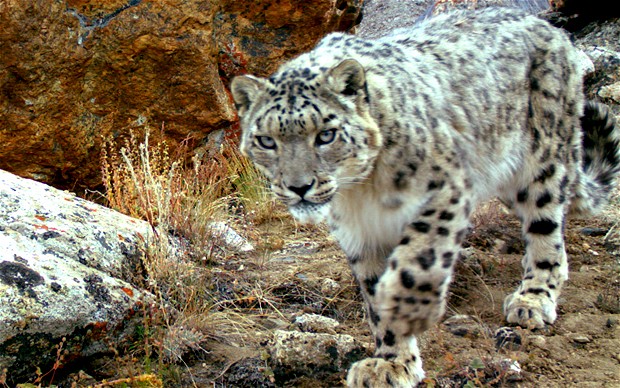
CHITRAL, Jan 26: Snow leopard was spotted in the forests near Bakamak and Shali villages in Chitral district on Wednesday and Thursday after long disappearance.

An official of the local wildlife department told Dawn on Thursday that the big cat appeared near Bakamak and Shali areas but heavy snowfall forced it into moving to Toshi game reserve at lower altitude.

He said snow leopard hadn’t been seen in the area over the last two years amidst fears about its extinction.

People thronged the Garam Chashma Road to catch a glimpse of the leopard.

The wildlife department official said the big cat descended to the areas of low altitudes in search of food after heavy snow in forests and high mountains and that small animals, including markhor and ibex, were its cherished food.

People fear attacks on them and their livestock by the big cat, especially at nighttime.

Ejaz Ahmad, a biodiversity specialist, said snow leopard lived in areas alongside Hindu Kush range of mountains.

He said leopard was declared an endangered specie in the recent past but its population density later surged satisfactorily.

Mr Ejaz said massive grazing in alpine rangeland, human conflicts, climatic change and decline in snowfall had led to reduction in the number of leopards. He said WWF had launched a snow leopard welfare project in some Chitral villages.

Meanwhile, Dinar Shah, in his eighties and from Seen village, said previously, people used to guard their families and livestock at nighttime but installation of bulbs around the village had curtailed leopard attacks.

He said leopard’s attacks on people were very rare as it targeted livestock, especially goats, only. He said the former Chitral rulers banned leopard killing but lifted the ban in view of growing cases of its attacks on livestock.

Some regretted that leopard was poached in the area for skin, which had a great demand in national and international market, without let or hindrance. They demanded registration of cases against leopard poachers.

http://articles.timesofindia.indiatimes.com/2012-01-24/lucknow/30658427_1_ips-cells-monash-institute-cell-types

LUCKNOW: The cultivation of embryonic stem-like cells made up from the tissue of an adult leopard, by Rajneesh Verma, has come as a ray of hope for scientists working to save the snow leopard. Rajneesh, a native of Lucknow is presently working at Monash University in Melbourne, Australia.

Rajneesh has pursued his studies from City Montessori School (till Class X) and Colvin Taluqdar’s (Class 12). After this he went to Australia from where he completed his BSc in biotechnology from Monash University. Having got a scholarship, he then joined MSc biotechnology, and is now a PhD student at Monash Institute of Medical Research (MIMR).

Elated on the discovery, his brother Maneesh said, “Rajneesh was fascinated with big cats since childhood. His findings prove that he is concerned about the extinction of the animal and hence putting all his efforts to save them. He will now apply the stem cell technique to other members of cat family, including the Bengal Tiger, and Jaguar.”

This study has been published in an international journal, Theriogenology. Rajneesh was supervised by Dr Paul Verma, also from MIMR.

It was through the use of ear tissue samples from adult snow leopards at Mogo Zoo, in New South Wales, Australia, that the researchers have generated induced pluripotent stem cells (iPS) cells which share many properties of embryonic stem cells. Verma said that it is for the first time that iPS cells have been generated from a member of a cat family. According to him, the finding raises the possibility of cryopreservation of genetic material for future cloning and other assisted reproduction techniques.

The researchers said that the finding is significant as obtaining reproductive cells, or gametes, even from animals in captivity is a herculean task. Elaborating how the stem cell can save snow leopard, Verma said, “Stem cells can well differentiate between various cell types in the body. In other words, these cells have the potential to convert into gametes. In fact, mouse iPS cells have given birth to entire offspring.” Hence, the study benefits the conservation of cat species, and biodiversity.

The researchers further added, “The first step in creating reproductive cells from adult tissues of an endangered animal has been accomplished by generating these stem cells. Next, we aim to harness the potential of iPS cells and create offspring. This will help to save species from extinction.”

http://www.dailytimes.com.pk/default.asp?page=2012\01\23\story_23-1-2012_pg7_10

KARACHI: As many as 2,500 people from various spheres of life, including schools, colleges and universities students, participated in annual Travelling Nature Carnival held here at PAF Museum Sunday, organised by World Wide Fund for Nature (WWF)-Pakistan in collaboration with Indus Motor Company (IMC).

The carnival was aimed at motivating and involving youth and general public in valuing the rich natural heritage of Pakistan, and supporting conservation initiatives.

Among its several engaging activities, the most innovative was the 3D display model competition. Hundreds of students participated in live presentations to the judges and guests, featuring themes such as habitat conservation of endangered species (snow leopard, green turtle, Indus dolphin), water conservation, a green idea, solid waste management (recycle, reuse, reduce), global warming and climate change, ecotourism, energy conservation, and green architecture.

The winning institutes were bestowed with shields and certificates. There were 150 stalls set up by schools, universities and commercial entities.

The carnival also arranged environment puppet show, live musical performance, magic show, environment games and quizzes, nature art exhibition, theatre, and environment debate competition.

Speaking on the occasion, WWF-Pakistan’s Regional Director Rab Nawaz pointed out that through the carnival environmental messages could be conveyed to the large number of audience. He further said that children are the stewards for change; they should be equipped with conservation practices, he urged.

Senior Manager Corporate Relation, WWF Pakistan Marriyum Aurangzeb said that for past 10 years, WWF Pakistan’s nature carnival had been playing its role as a unique endeavour that brought together thousands of visitors, such as students, families, corporate sector, media, government organisations, conservation organisations and general public. It provides a collective platform for building knowledge and interest in responsible action, ecologically conscious development and sustainable living.

MD IMC Pervaiz Ghias was the guest of honour at the carnival. While speaking to the participants, he said that the Toyota environmental programme launched in 2011, in partnership with WWF-Pakistan, being implemented in 100 schools, 15 colleges and 10 universities, was a great success.

IMC is proud to be a part of the carnival and hopes to make the young generation of Pakistan an environmentally sensitive generation and a guardian of our natural resources.

Programme Coordinator Indus for All Programme Nasir Ali Panhwar stressed on the unique nature of carnival in terms of establishing diverse level of participation and an integrated approach towards nature conservation. He highlighted need of creating awareness about environmental issues with support of media.

http://www.expatica.com/nl/news/dutch-news/dutch-police-find-40-boxes-of-rare-animal-bones_202642.html

Dutch police find 40 boxes of rare animal bones

Two Dutch men were arrested after police discovered 40 boxes filled with animal bones, including those of a rare snow leopard, in the northeastern city of Emmen, a police spokesman said Friday.

“Police received a tip-off about the men and when they searched two homes on Thursday, they found chimpanzee, crocodile and hippopotamus skeletons and even the skull of rare snow leopard, as well as ivory,” Ron Reinds told AFP.

The father and son, aged 54 and 31, could not explain why the skeletons were in their possession and they were arrested, said Reinds, adding the men are being investigated under Dutch fauna and flora legislation.

Described by the International Union for Conservation of Nature’s Red List as endangered, the snow leopard is found in the high mountains of central Asia.

There are an estimated 4,000 to 6,500 of the animals left, according to the IUCN.

© 2011 AFP

Congratulations to all the SLN members involved in this project!

Tajik snow leopard

Telegraph.co.uk – A British-lead team of scientists has snapped rare intimate photographs of the elusive snow leopard on a remote mountain on the Tajik-Afghan border.

The photographs of the five snow leopards over a two month period in former Soviet Tajikistan suggest that the scientists may have discovered a hotspot for the endangered cat.

Dr Alex Diment, a scientist with Cambridge-based conservationist group Fauna and Flora International, was the expedition manager on the team of 25 people.

He described how they set up camera traps triggered by motion sensors along the side of an untouched valley for two weeks in August.

“We went up into the Wakhan range which is a mountain range on the border with Afghanistan,” Dr Diment said. “We’re pretty sure that it has never been surveyed for bio-diversity in that region.”

Snow leopards are so agile and so elusive that it is impossible for humans to physically track them.

Also in the group was Dr David Mallon, a snow leopard expert who is attached to Manchester Metropolitan University and is chairman of the Snow Leopard Network, a group dedicated to conserving the snow leopard.

Ten other scientists were Tajiks and the rest of the team were support staff.

The group returned to the valley two months later to collect their cameras and inspect the photographs.

“It was really surprising to have so many individuals,” he said of the snow leopards in the photographs. “I thought we might get one or two but to get five individuals in a small area, including a family with cubs was a great surprise. It was very exciting.”

The spotted pattern on the snow leopards’ white, grey body is unique to each cat, meaning they can be individually identified.

There are only an estimated 3,000 to 8,000 snow leopards left in the world. The wide estimate demonstrates the snow leopards’ elusiveness.

They typically live above an altitude of 4,000m on remote craggy mountains in Central Asia, China and Afghanistan. Trapping for their coats and a drop in prey have hit the snow leopard and driven them to the edge of extinction.

Photographs of the two cubs show them inspecting the cameras before they became so curious that they actually took one of the cameras away.

“We came back and we were missing a camera but had no idea what could have happened to it,” Dr Diment said.

The team searched without success and it wasn’t until they returned to the nearest city and looked at the memory card of another camera that they discovered the truth.

“There was the culprit stealing the camera,” he said. “They stole one of the cameras but the paired camera pointing at the other one showed them nicking it.”

Snow leopards retain a mystical allure in Central Asia and are depicted on the emblems of cities and organisations across the region. Almaty, Central Asia’s financial capital, and Bishkek, the Kyrgyz capital, both have snow leopards on their emblems.

In the Soviet Union, mountaineers who climbed all five peaks over the 7,000 metres were given the Snow Leopard Award.

http://www.telegraph.co.uk/news/worldnews/asia/tajikistan/9025294/Scientists-snap-rare-photos-of-snow-leopards-in-Tajikistan.html

Voting for the 2012-2014 Snow Leopard Network Steering Committee was recently concluded.

Thank you to all members who voted, and congratulations to the newly elected Steering Committee members, who are as follows:

Chair:
David Mallon, Ph.D., Manchester Metropolitan University, UK

Members:
Yash Veer Bhatnagar, Ph.D., Nature Conservation Foundation and Snow Leopard Trust (India Program)

Mukesh Chalise, Ph.D., Tribhuvan University, Nepal

Ahmad Khan, WWF Pakistan/Pakistan Wetlands Programme

Sibylle Noras, Snow Leopard Blog, Australia

Jennifer Snell Rullman, Snow Leopard Trust, USA

Dajun Wang, Ph.D., Peking University and Shanshui Conservation Centre, China

snow leopard and cub afghanistan

WCS – Photographing snow leopards with remote cameras in Afghanistan is hard, which is why a team of WCS conservationists was delighted to take this recent image from a craggy peak in Afghanistan’s Sarkund Valley. This is the first image of a mother and cub taken since WCS began work in the region. WCS has been conserving wildlife and improving local livelihoods in Afghanistan since 2006 with support from the U.S. Agency for International Development.

http://www.wcs.org/multimedia/photos/rare-family-snapshot-leopard.aspx


Educational Booklet designed for teachers. It offers a lesson plan using ancient Buddhist stories as well as the information on snow leopard in Bhutan. This booklet is a product of a Snow Leopard Conservation Grant.